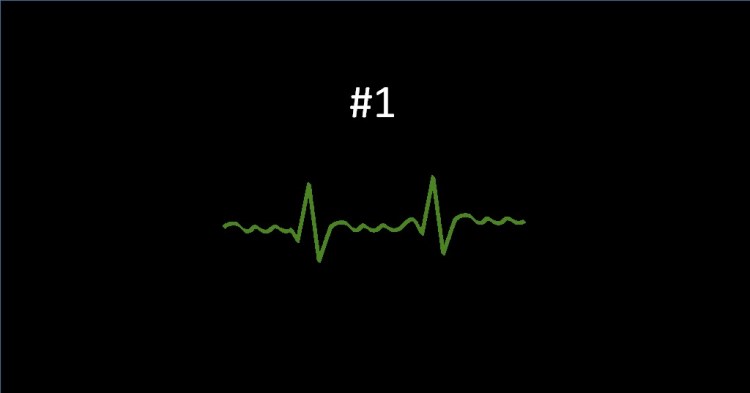
My first AFib-Episode happend when I was visiting a new day clinic to find myself a more suitable approach for coaching me out of my diagnosed “Burnout”-Condition. Before that visit I had some short trials in different therapeuthic approaches and slowly started asking myself, how should anyone could get healthy in such a clinical sorrounding. In those days it was the first time in my life being on some medication for blood pressure and anti-depression. I was still taking these meds for some weeks at that point. I never felt comfortable with this kind of “pill”-therapy, but I was new in “business” and listened to my doctors and took that stuff as commanded and as said for my own “safety”. But to be honest I always wanted to get rid of it as soon as possible, because no checkup until that time had ever been shown any structural problem or risk factors inside my body. So I started getting unsure about why I should take those heavy meds probably for lifetime. Another point was I felt many medication sideeffects, but no real benefits.
On that day, in the new clinic, I felt very uneasily. My heart was having extra beats all the time and I got more and more anxious. After some time waiting for my date with the new “Burnout”-Coach I decided better to go to the emergency room next door for a checkup what’s going on there. First the nurse told me everything is allright, no need to worry, I was relieved, but than a doctor jumped in and said I immediately have to lay down and wait for further instructions. Later he came in again and told me together with a colleague that they have found a slight “ST-Depression” in the ECG and I might have had a heart attack, but to be really sure they need to do a catheter analyses of the hearts blood vessels. I was shocked, but I remembered (by coincidence) that there was a less invasive possibility existing to check the hearts condition by doing an MRT. I told them that I would prefer this kind of checkup if possible , because in meanwhile I had no symptoms anymore. The two doctors discussed this with their head physician and later on agreed that this could be a solution too to do an MRT, but anyway I have to stay in hospital until the next day.
The next day another ECG was done and it looked Ok again so the doctors decided to check me out. In meanwhile I found out myself, together with “Doctor-Google” that a ST-Depression might be temporary caused by hyperventilation and a low potassium level too. I was remembering that the day before I was hyperventilating and it was shown by a bloodcheck that I was also low on potassium while the ECG was done, so this was at least the most senseful explanation for my condition. (Note: A Hyperventilation Syndrom might be caused by anxiety or stress also at healthy people and then is commonly not to be seen as a life threatening condition. A temporary low potassium level might be also a cause of hyperventilating.)
So after everything turned out to be great I packed my stuff together and got ready to leave the clinic. But than something strange happend. After getting up my heart startet to speed up and up and up. I somehow brought myself to the nurse room and told them something is really really wrong. First they thought it was some kind of a panic attack and brought me back to my room to calm down, but it felt very differently to anything I ever had experienced before. Than after breaking through a heartbeat of >180 bpm the cardiologist and many other people with white and blue coates came into my room. I grabbed the hand of the doctor while another ECG was plugged on and said “Please stay with me, I think this is the end.”. He looked at me, stopped for a short while and than said: “Hm, no, I don’t think so, but I need to go to fetch some meds for you, but I will be back in a second”. Meanwhile the ECG-machine said “Atrial Fibrillation”.
After my heart was speeding up that much it also got into irregular rhythm too, I really thought: “That’s it, it’s over now.”
As a next step the doctor explained me that I will not die, but it might be necessary to do a cardioversion to put my heart back into rhythm. After that I had to sign some formulars. Then the doctor said: “Maybe we better wait for some hours and see if the heart maybe jumps back into sinus rhythm from alone. If not we do a cardioversion.”
I was very happy (because of several reasons, some I should get to know later) that my heart jumped back into sinus from alone after a couple of hours and I have not done a cardioversion.
The next two days many more checkups were done, but no structural heart problem was found. But what had been found was that the antidepressant medication, maybe in combination with the blood pressure agents I got, did a change to the ventricular repolarisation time of the heart named QT-Prolongation. This at least meant in my case that the hearts functionality has been temporarily disturbed by the interference of drugs.
The QT-Prolongation had neutralised itself after a reduction of the medication plan. So I thought everything is allright again,…but it wasn’t. My new friend AFib would come back again.
So at least and after all of that no one really told me about the cause of this first episode. I only got a short introduction into the risks of Atrial Fibrillation (AFib) and was put on a complete new medication plan including an anticoagulant also known as “blood thinner”. (Note: An anticoagulant is technically not really a “blood thinner” in the meaning of its words.) I was also told that based on the CHA2DS2-VASc scoring index for stroke risks it might be considerable to set off the anticoagulant later again, because my score is somewhere between 0 and 1.
The next day I had left the hospital.
My personal conclusion (not a medical advice!):
To be honest, after my first AFib episode, I was really shocked (but not electrically as planned before) about this very non empathic medical system dropping me back on the street again without any further explanation or maybe some hope for a cure or something I can hold on myself.
I wouldn’t blame these two doctors, because of their wrong diagnosis and their plan of doing a catheter analysis. At least I think they really wanted to help me and my “Dr. Google – selfdiagnoses” could also have been turned out to be very wrong too. At that point of my knowledge it was maybe more a lucky shot than a self diagnosis.
A little bit more problematic seems to me that I as a patient was better informed about non invasive and less dangerous options for a heart vessel analysis than the professional health care personal.
Another critical point adresses the time before my first episode started. My first medication plan was given on very low Information about my real constitution. For example I got strong blood pressure agents without any 24h-monitoring and no one was caring about the question, if someone like me who has been diagnosed as a “Burnout”-Candidate might need a complete different treatment than a symptomatic medication plan for just “striking down” temporarily symptoms. Another sad fact was that my blood pressure readings were also raised, because of something called “White Coat Syndrom”, what means higher blood pressure readings, because of anxiety only in a clinical surrounding.
There was some relation in the timeline of my first AFib episode and the intake of that new medication, but that was never discussed by any doctor. From the beginning on I got a very close sympomatic treatment immediately supported by strong drugs, without any clear diagnosis. From a holistic medicine perspective (like in Traditional Chinese Medicine “TCM”, Ayurverda, Natural Healing, etc.) you can not just “fix” a symptom before you don’t understand why it comes up. If you do like that you could get a “boomerang”-effect. This might have happend to me. In a holistic approach every symptom is seen like a message from the body. A Natural Healer told me later on: “Your body has no cell phone, so he calls you by symptoms.”.
I had ignored my symptoms for a long time until they got that strong that I “woke up” and my options limited themselves to getting medical attention. That was my first “mistake”. The second “mistake”, in my opinion, was immediately surpressing the symptoms by drugs, rather than trying to find and cure the cause at the first place.
Another point, in my eyes is, the mixing up of a “Burnout”-Condition with a “Depression”-Condition (especially when medication comes into the game). In my experience this “mix up” happens very often and is the standard in many clinical treatments and this could be misleading. Example: Being completely exhausted in a “Burnout”-Condition from a job or a home care situation of a close relative it might be helpful to be shipped to a “quiet lonely island” getting rid of all stress, harmful conditions and some people for a while. But being inside of a deep major “Depression”-Condition , it might be life threatening being shipped to that same quiet lonely island.
What did I learn until this point (not a medical advice):
- I should have been more self reflective about my life and my personal priorities.
- “Breaking your Limits”-does not always mean to put something “more” into your life, it could also mean to get rid of something.
(Sometimes getting rid of something “Like firing your boss, etc.” is much more challenging but helpful than putting something on top.) - Being a little bit more thankful for every healthy day I had, wouldn’t be wrong.
- Trusting much more into my body’s abilities is a big advantage.
(My body is not my enemy, it is my “brother in arms”.) - Being much more sceptic and reflective about “a pill solves all your problems”-Promises can be very self protective.
Please always remind the Disclaimer as a condition of using this blog.
 Get rid of AFib Blog